How this market works
Med spa demand tracks discretionary income far more closely than population. The service is elective, largely cash-pay, and concentrated in a relatively narrow band of households, which means two cities of identical size can support very different numbers of clinics. The neighborhood income view is the single most useful screen in this vertical.
Supply is harder to pin down than in licensed trades, because the category sits between medical and personal care and businesses classify themselves inconsistently. The report counts live listings rather than a registry, so treat the competitor count as the visible market rather than a legal register.
Is there room for another med spa here, and what would it be worth?
What this market looks like nationally
We measured these from live business listings across six mid-size metros and from published federal business statistics. They are the yardstick every scan is scored against, so a city reading above or below them is the actual signal.
In a city of 250,000 that works out to roughly 43 med spas sharing a market of about $6.7M a year. Your city will differ, which is the point of scanning it.
What the report shows
- Household income and home values by neighborhood, the clearest predictor of elective spend.
- Competing clinics with ratings and branded search volume, which reveals who owns local mindshare.
- Search demand across injectables, laser and skin treatments separately.
- Busy hours for walk-in traffic where the data exists.
Every figure names its source and shows the arithmetic behind it, so you can argue with any input rather than taking a score on faith. See how the math is shown.
A real scan: Scottsdale, AZ
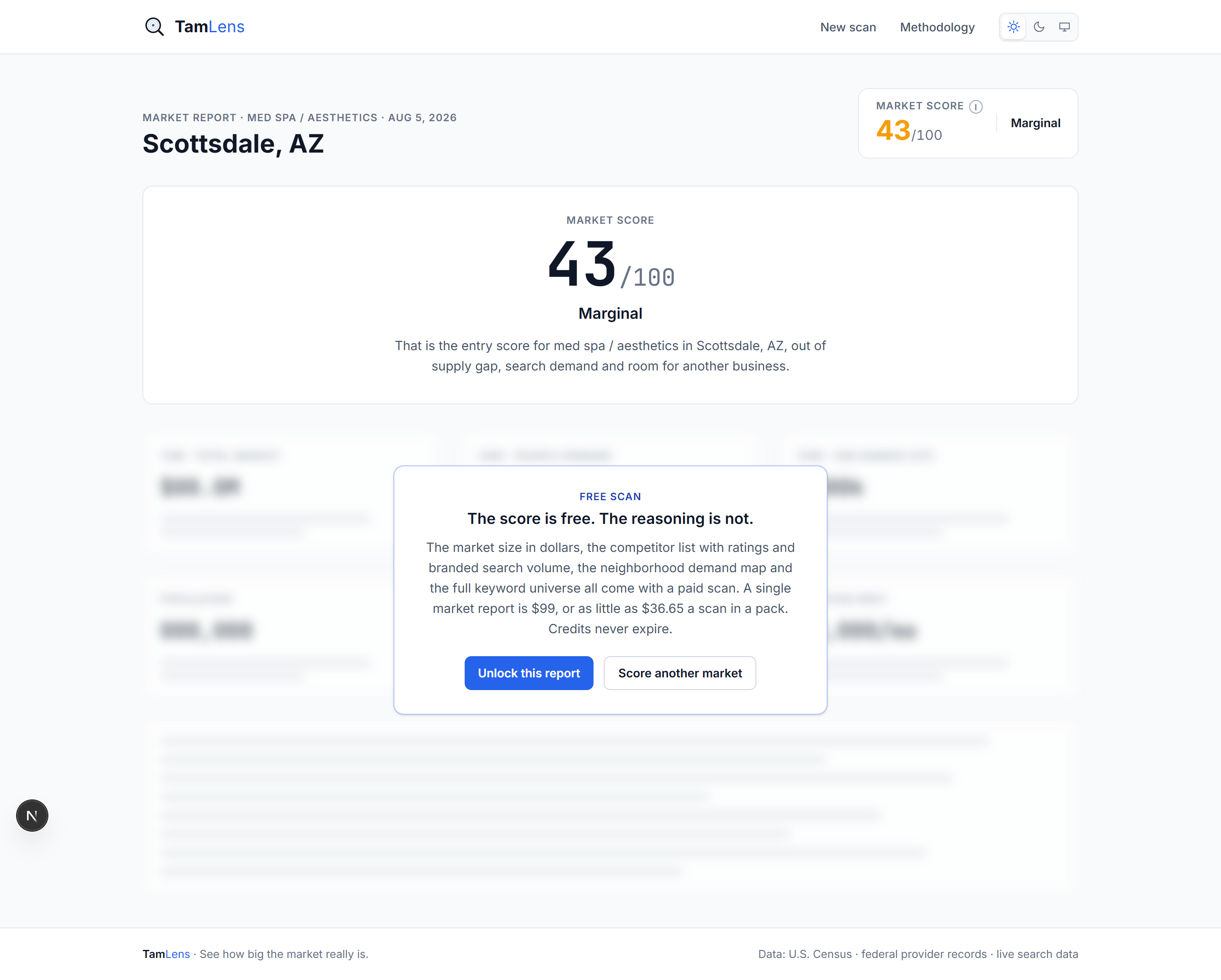
Income by neighborhood
Who runs this scan
Practitioners opening a first clinic, multi-site operators screening expansion metros, and agencies building aesthetics lead generation.
Common questions
Why is this vertical marked as estimated?
Because the published industry statistics do not cleanly separate medical aesthetics from general personal care, we keep researched figures rather than borrowing a poor match. The report says so on the page, and the competitor and search data are still live.
Does it distinguish injectables from laser work?
In the keyword universe, yes. You can see relative demand for botox, fillers, laser hair removal and skin treatments in the metro.
Is income really the deciding factor?
It is the strongest single screen, but not the only one. A high-income neighborhood already served by four established clinics is a worse bet than a middling one with none, which is what the score weighs.